

I must admit that in the three years since the release of Everything Everywhere All At Once, much of what lingered with me was a vague feeling. It felt weird to discuss it with people who had also seen it, because they would go on and on about the sausage fingers scene and the bagel. Thankfully, what I did agree on with most people is that Waymond is one of the greatest characters in media—and if this post must become Waymond agitprop, I have no problem with it.
However, I was reminded about the movie again recently, and it seems that two semesters at a liberal arts university have made the gears in my brain turn in a different way. I definitely have a new appreciation for the actual, tangible themes of EEAAO. But, perhaps more importantly, I finally understand what it is that stuck with me about this (not pulling my punches here) 21st century masterpiece—a revelation that I will lovingly share with you, at no cost whatsoever. Unless you want to leave a tip.
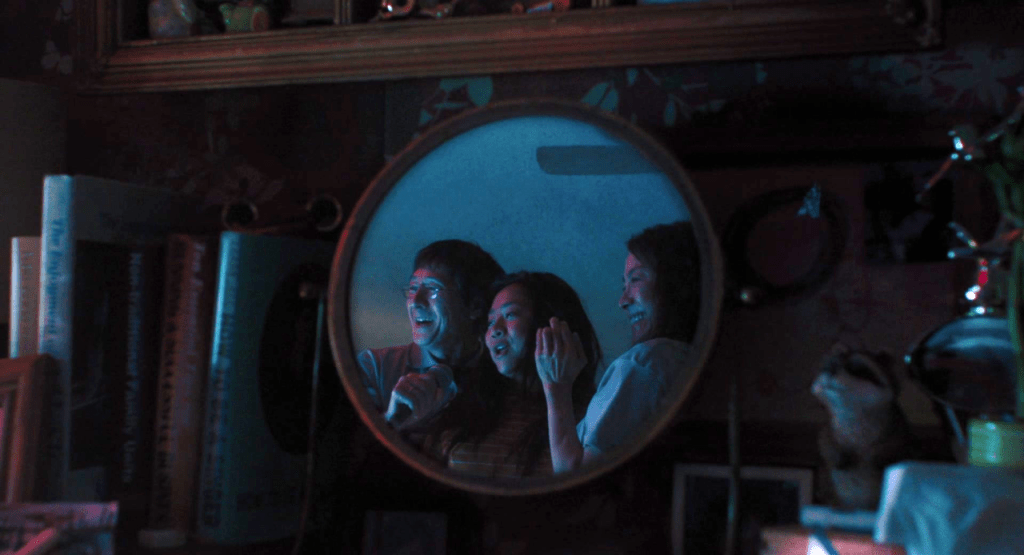
Perhaps the first place to start is not actually the very beginning (although the first 50 seconds of this movie are so ridiculously good it’s hard to put into words). Instead, I’m going to assume you already watched EEAAO (WHICH YOU SHOULD! SPOILERS! BE WARNED!) and skip ahead to Evelyn’s first jump. This is the point where the movie finally blooms, and shows you its true colors. Surprise! Here is the multiverse. It never quite made sense to me why exactly all of this was happening to her, to Evelyn. With a little care, this is a line you can trace across the entire movie, and finally answer with Alpha-Waymond’s claim that Evelyn, this Evelyn, is the biggest of every failure in the multiverse. THE biggest failure. And finally here we get to the first instance of the movie’s titular claim to fame. It is the biggest story, the best story, the story with the people that lived life the worst and the people that lived life the best. Also, it’s the story of two people running a laundromat.
And it is this paradox that carries the movie on its back. This is the paradox that gives it its title. But there is a problem. A massive problem, actually. The movie spends about half of its runtime opening doors: first the multiverse, with Evelyn being the worst Evelyn. Then Jobu Tupaki, who is every Joy. A million versions of Deirdre. A million universes. Wrestling, milk, the Everything Donut, everything. But in order to accomplish the paradox, in order to close back on the laundromat, the movie needs that brooch. It needs a way to close every door at once. It needs to make sense to the viewer again.

The answer is WAYMOND WANG. Waymond is the fucking pin on the massive, flowing cape that is this movie. I want people to know that without Waymond, this movie makes no sense. And so we have reached my favorite point of the movie (and many other people’s favorite). The quote by Waymond, “So, even you have broken my heart yet again, I wanted to say… In another life, I would have really liked just doing laundry and taxes with you.”
Waymond is not Evelyn’s husband. He is not Joy’s father. Waymond is a man who looks at every possibility, at every concept beyond his understanding, and could not care less. Evelyn and Joy are by design two sides of the same coin, both focused on what they could be or could have been. And indeed, up to the quote, that is what this movie has been: an exploration, a vision of a world with a hero and a villain and a billion plot points. And in less than 20 seconds, Waymond stops the movie dead on its tracks. No, he says. The world is me and you, here. The world is when I kiss you and we watch a movie on the couch with our daughter.

I will not deny that the central plot of the movie is Evelyn and Joy’s dynamic. That would be insincere. But I think the role that Waymond plays is a necessary second. This is an incredibly difficult dynamic to pull off: Evelyn and Joy, equals in ambition, and Waymond—the laundry guy. What happens to the movie without him? A mom fights her daughter over a difference in opinion.
And yet, Waymond’s presence in the narrative makes something new entirely. A mom fights her daughter over a difference in opinion. It is a fight with infinite stakes, stakes that the audience cannot quantify. But the mom’s husband, and the daughter’s dad, he is a fixed point. Evelyn and Joy become stronger, more powerful, they want to save the world, or end it. And Waymond? Waymond loved them at the beginning, and he loves them at the end. He really would have loved just doing laundry and taxes with her. What?
The universe has everything in it. There are more atoms in a cloud than words you could ever speak. There is a number of people you could talk to that is an infinitesimal fraction of all the people who have ever been alive. And yet, you are allowed to love. In fact, the only thing you can do is love, and do menial things. Being the best at anything is a trick of the light, the only thing you can be best at is what you are currently doing, right now. Hugging friends you see after a long time, liking stories, forcing yourself out of bed and to your classes. Your laundry, your taxes. Give it your all.
She said, “you just worry about your groomsmen and your shirt size” //
And rest assured that this is making me feel good //
I think that love is so much easier than you realize //
If you can give yourself to someone, then you should.
A Little Bit of Everything – Dawes


Leave a Reply