

Ah, Principia Mathematica. The 456-page universal mathematical framework that was practically nuh-uh’d out of existence by Einstein’s bestie. Pages and pages and pages of endless set theory and syntax that would make a RegEx programmer vomit, intended to prove, for once and for all, that– among many other things– one plus one did indeed equal two. And yet, it very famously did not success, and for obvious reasons: even if you can prove 1 + 1 = 2 using set theory, how can you prove that the set theory you used is based on logic, too? Like an annoying kid who keeps asking “but why?” to any attempt of an explanation, Gödel answered brutally with his incompleteness theorem: in any mathematical system, there will always be some truth that cannot be proven.
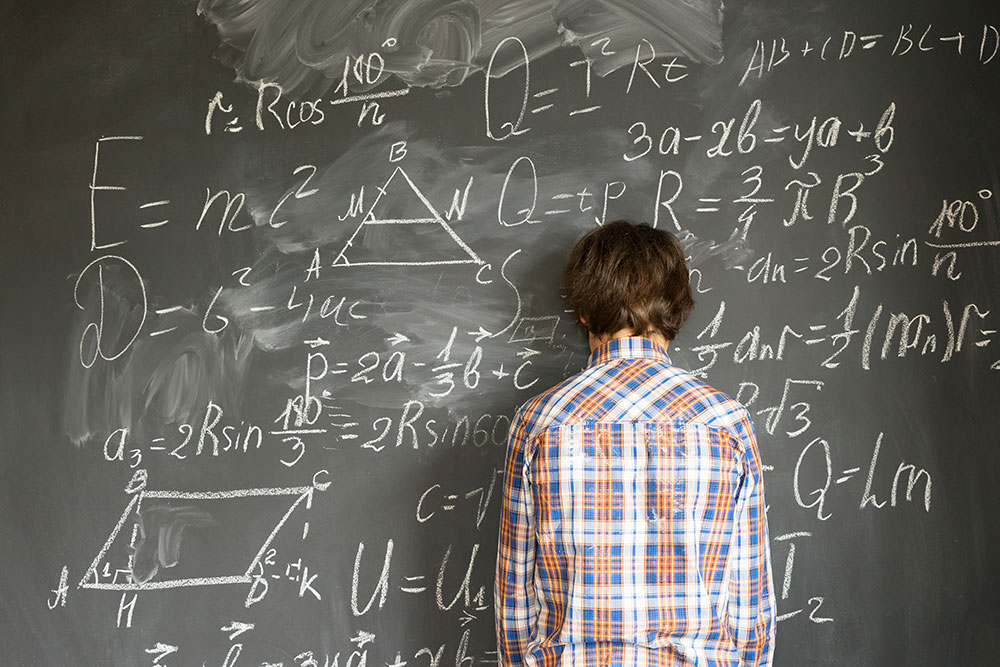
Enter me in the shower three days ago, with a thought a-thinkin’ in my head. Clearly, Gödel’s incompleteness theorem can be applied to other aspects of the universe around us: if everything is made of atoms, and atoms are made of sub-atomic particles, and those sub-atomic particles are themselves made of particles, then what’s at the bottom? But we don’t need to know. We only need to know that there is something at the bottom, because then we can ask “and how is that there?” Regardless of whether it’s 10-dimensional strings or some strange non-descript matter, that something is there arbitrarily. In fact, it doesn’t even have to be matter. Light travels at 3.0 * 10^8 m/s. Why? Even if there is some underlying phenomenon that explains the speed of light, what is the explanation for that phenomenon? You can see how this spirals out of control quickly.
So here’s my idea. While this is a very solid foundation for a simulation theory of sorts, we can also try to apply the phenomena we see on our own environment– in this case, evolution. What if– and bear with me here– what if the universe is constantly big-banging itself, changing some fundamental aspect of itself every time it does (what 1 plus 1 equals, the speed of light, even the very concept of time and space), in search of some goal hopelessly beyond our own imagination? What if, alternatively, there is no goal? What if the universe is just compelled to try every possibility for any combination of fundamental truths?

I’ll try to keep this post short, mostly because that’s really about as far as I was able to take this theory. If anyone can think of any gotchas against my theory, or any interesting ramifications this could have on our understanding of the universe, feel free to drop them in the comments. Stay frosty!
 Tiny Hydra
Leave a comment