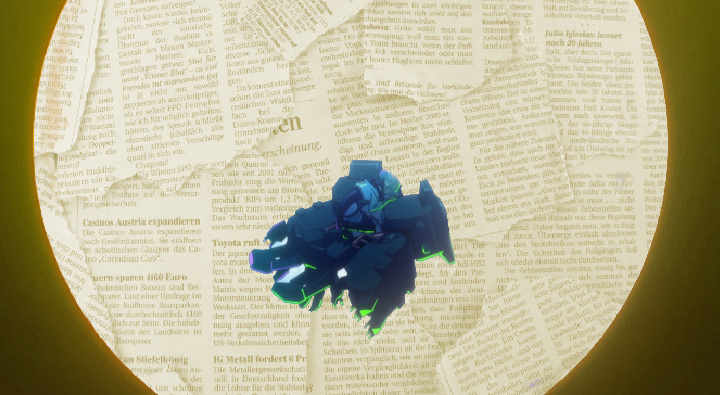

The modern night sky has, effectively, been mutilated. The idea that the stars could one day simply dissappear from the night sky would seem preposterous to any 18th century scholar, yet we pay little mind today when we look up to see a naked sky. Stripped, however ingloriously, of its shiny sequins, there does still remain a single monument in the deep blue of our infinite cosmos. A monument that has remained, unmoving, for countless generations, and whose dull light has been examined as thoroughly by us as it has by cavemen before the invention of fire: the Moon.
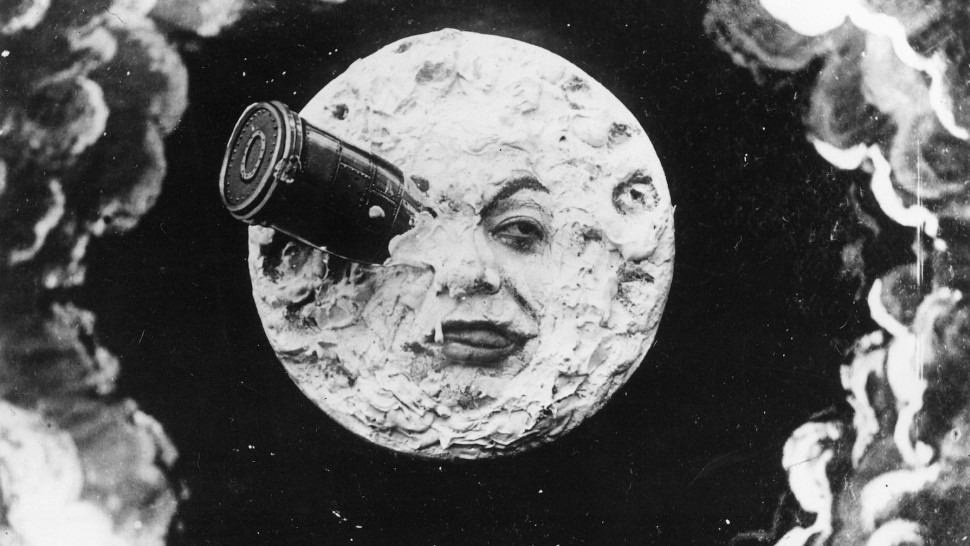
Le voyage dans le lune’s moon scene is perhaps one of the most iconic in silent media
It goes without saying that the Moon is and always has been an object of fascination. The Wikipedia page for “List of appearances of the Moon in fiction” alone has 438 entries, ranging from the 2020s to before the invention of the telescope. But there are a few series which have always stood out to me, and one in specific which I only recently finished, and which has almost entirely captivated me long after its individual scenes faded from my memory.
2022’s Cyberpunk: Edgerunners is a show, based on a videogame, whose premiere alone caused a staggering 70% increase in said videogame’s sales. In my list of “Top 10 Best Pieces of Media I have ever Watched,” Edgerunners stands at a glorious 3rd place. What’s more, Edgerunners also happens to heavily feature our silvery subject. What a coincidence! The Moon in Edgerunners, however, is not simply a prop. It doesn’t stand in the night sky, looking pretty, and give up its influence when it fades into the morning. Indeed, in a show which takes place almost entirely at night– whose main setting is Night City— the Moon is almost always present. Not as part of the background, no, but as a character itself.

The lighting in this scene is just fantastic.
At first, I thought the Moon represented nature: in a world ravaged by progress, by neon lights and neon dreams, an orb of dull rock was the only visible location untouched by man. When the show later revealed that the Moon was no desert, but a tourist attraction of sorts, it only heightened my interest. It was, in a way, still a symbol of nature. No amount of colonization could make even the smallest mark on the Moon. The presence of life was overshadowed by the absence of life. But I also started to see it in a different way. You see, at this point, it was revealed that one of the secondary characters, Lucy, had one goal in life, and one goal only: to get to the Moon.
And then, it all clicked. In a world where you can do anything, it makes sense to reach for the one thing that is out of reach! To do anything for a goal so absurd, that its completion alone will keep you going forever! To grab that little mystery, that tiny speck of the universe that escapes our intellectual grasp, and crush it for once and for all! Then, finally, we can triumph over all. But by then, it was too late. Because I had already fallen into Edgerunner’s ultimate trap. Indeed, I had falled into a trap that trascends media. The intellectual spike pit that had troubled generations of politicians, philosophers, scientists: then what?

Then what?
Then what? Mars? Jupiter? The Andromeda galaxy? In Blood Meridian, Judge Holden catalogs every bug, every plant, every tree, in an effort to “enshrine his grasp over the chaos of nature”. It is framed as a comically futile endeavor. Why? Who is Judge Holden? How could he ever have believed that would work? In Asimov’s The Last Question, our encroaching expansion of the universe dooms us all to nothingness. If not expand, if not to want more, then how could we possibly give meaning to our lives!?
The end of Edgerunners is extremely grim. For the sake of spoilers, I won’t reveal any part of it here– perhaps a first for me when it comes to dealing with these sorts of things. The Moon, ultimately, is unmoved, just as Nature in’t in Blood Meridian, and the universe isn’t in The Last Question. The Moon exists beyond it’s celestial body: it’s a monument. A monument to nothingness. We love it, perhaps, because we cannot understand it, and Lucy cannot understand it either. Edgerunners, at its core, is a tale of absurdity, and you can’t blame it: when the world is against you, sometimes the only thing you can do is let yourself go.
 Tiny Hydra
Leave a comment